

Most of us replace our shower puff every few weeks without thinking much about it. It gets a little limp, a little grey, maybe starts smelling strange and into the bin it goes.
But here's what we don't often stop to consider: what's actually happening inside that pink mesh ball between washes?
The answer might make you want to bin it today.
The Bacteria Problem Nobody Talks About
Research published in the Journal of Clinical Microbiology found that synthetic loofahs can harbour significant levels of bacteria, including Pseudomonas aeruginosa, a pathogen linked to skin infections, particularly in people with compromised immune systems or eczema.
How does this happen? It comes down to design.
Synthetic shower puffs are made from layers of plastic mesh, usually nylon or polyester, that scrunch together into dozens of tight folds. These folds are perfect traps for dead skin cells, soap residue and moisture. And your bathroom? It's warm and humid. A near-perfect environment for microbial growth.
Every time you use your shower puff, you're exfoliating, which means you're depositing skin cells directly into those folds. Then you hang it back up, wet, in a steamy bathroom. And the cycle continues, day after day.
Studies have found that the centre of a synthetic loofah, where moisture is slowest to escape, can harbour bacterial colonies even after rinsing. One study found that bacteria persisted on synthetic loofahs after more than a week of regular use, even without visible signs of degradation.
The toilet seat comparison isn't just a hook. It's a genuine benchmark researchers have used to contextualise bacterial load on everyday bathroom objects. Synthetic loofahs consistently perform worse.
The Microplastics Problem Nobody Talks About Either
Bacteria aside, there's a second issue that's only recently gained mainstream attention: microplastics.
Every time a synthetic shower puff is used, tiny plastic fibres can shed from the mesh. These microplastics (particles smaller than 5mm) end up on your skin, in your drain, and ultimately in waterways.
Research into microplastic shedding from synthetic textiles has grown significantly over the past decade. Shower puffs, made from the same plastic fibres as synthetic clothing, are now understood to be a source of this shedding, particularly concerning because they're used directly against skin, often on sensitive areas, and in the same water you're washing yourself with.
For people managing eczema, sensitive skin or hormonal concerns, this is worth paying attention to. Microplastics have been found in human blood, lung tissue and even placentas. The long-term health implications are still being studied, but the precautionary principle applies: if you can choose an alternative that doesn't shed plastic, that's worth considering.
Why We've Normalised Something That Was Never Meant to Last
Part of the problem is that synthetic shower puffs were designed to be disposable. They're cheap, often $3–5 and broadly understood to need replacing every three to four weeks. Most dermatologists recommend it.
We've accepted that as normal. But "normal" doesn't mean optimal.
The disposable cycle also has an environmental cost. A single household goes through roughly 12–17 synthetic shower puffs a year. Multiply that across millions of Australian households, and you have an enormous volume of single-use plastic ending up in landfill or worse, waterways, annually.
What's Different About a Natural Sea Sponge
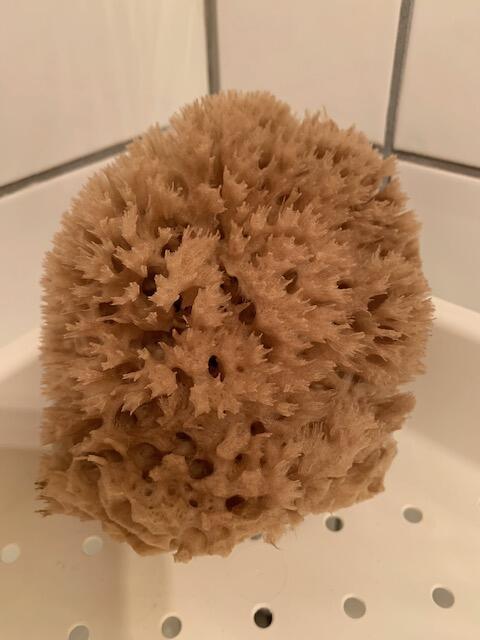
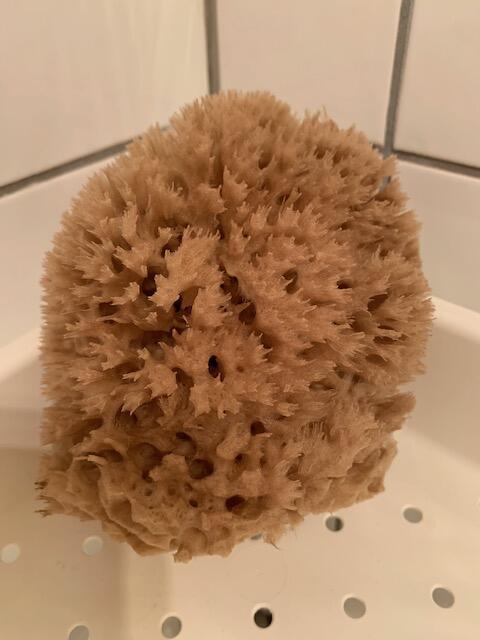
A natural sea sponge isn't designed in a factory. It grows in the sea, in this case, hand-harvested by traditional diving families from the waters around the Greek Islands, in the Aegean where sponge diving has been practised for centuries.
Structurally, it's the opposite of a synthetic puff.
Rather than tightly woven plastic mesh, a sea sponge has an open, porous structure that allows water to drain freely and air to circulate. It doesn't trap dead skin or soap residue in sealed-off folds. And because it's a natural material, it dries more efficiently, which is the single biggest factor in reducing bacterial growth on any bath tool.
Sea sponges also contain naturally occurring enzymes, including lysozyme, that have demonstrated antimicrobial properties. This isn't a marketing claim; it's part of the biological function of a sponge in its natural environment, where it needs to resist bacterial colonisation to survive.
For people with eczema, sensitive skin or conditions like rosacea, the texture difference matters too. Natural sea sponge is exceptionally soft, softer than any synthetic alternative, and creates a rich, gentle lather rather than mechanical abrasion.
And unlike a synthetic puff? It doesn't shed microplastics.
How Long Does a Natural Sea Sponge Last?
This is usually the first question, and fairly so, given the price difference.
A quality natural sea sponge, cared for properly, lasts 12 months or more. That's compared to a synthetic puff replaced every 3–4 weeks, meaning you'd go through roughly 12–17 puffs in the same period.
Care is simple: rinse after use, allow to dry between uses, and give it a monthly soak in water with a few drops of lemon juice or a small amount of bicarbonate of soda to keep it fresh.
Over a year, the cost comparison tends to be comparable or lower and without the ongoing waste.
Making the Swap
If you've been using a synthetic shower puff for years, the switch to a natural sea sponge can feel surprisingly different in the first few days, in a good way. The lather is richer. The texture is gentler. And a shower that's always felt functional suddenly feels a little more considered.
One of our customers described it this way: "I didn't realise how harsh my shower puff felt until I switched. My skin feels cleaner, softer, and my shower actually feels relaxing now."
That shift, from routine to ritual, is something we hear often. And once you've experienced it, the thought of going back to a scratchy pink mesh ball feels a bit absurd.
The Bottom Line
Your shower puff probably has more bacteria than your toilet seat. It's shedding microplastics onto your skin. And it's designed to be thrown away in three weeks.
None of that is inevitable. It's just what we've accepted because we didn't know there was a better option.
There is.
[Shop the Aqua Zoi Luxe Bath Sponge →]
Hand-harvested in Greece. Ships from Melbourne.
Sources available on request. Aqua Zoi is a Melbourne-based natural sea sponge brand sourcing hand-harvested sponges from traditional diving families in Kalymnos, Greece.

0 comments